
 English
 Español
 Русский
 عربي
5052 vs 6061 vs 7075 Aluminum: Material Selection for Sheet Metal and CNC Parts
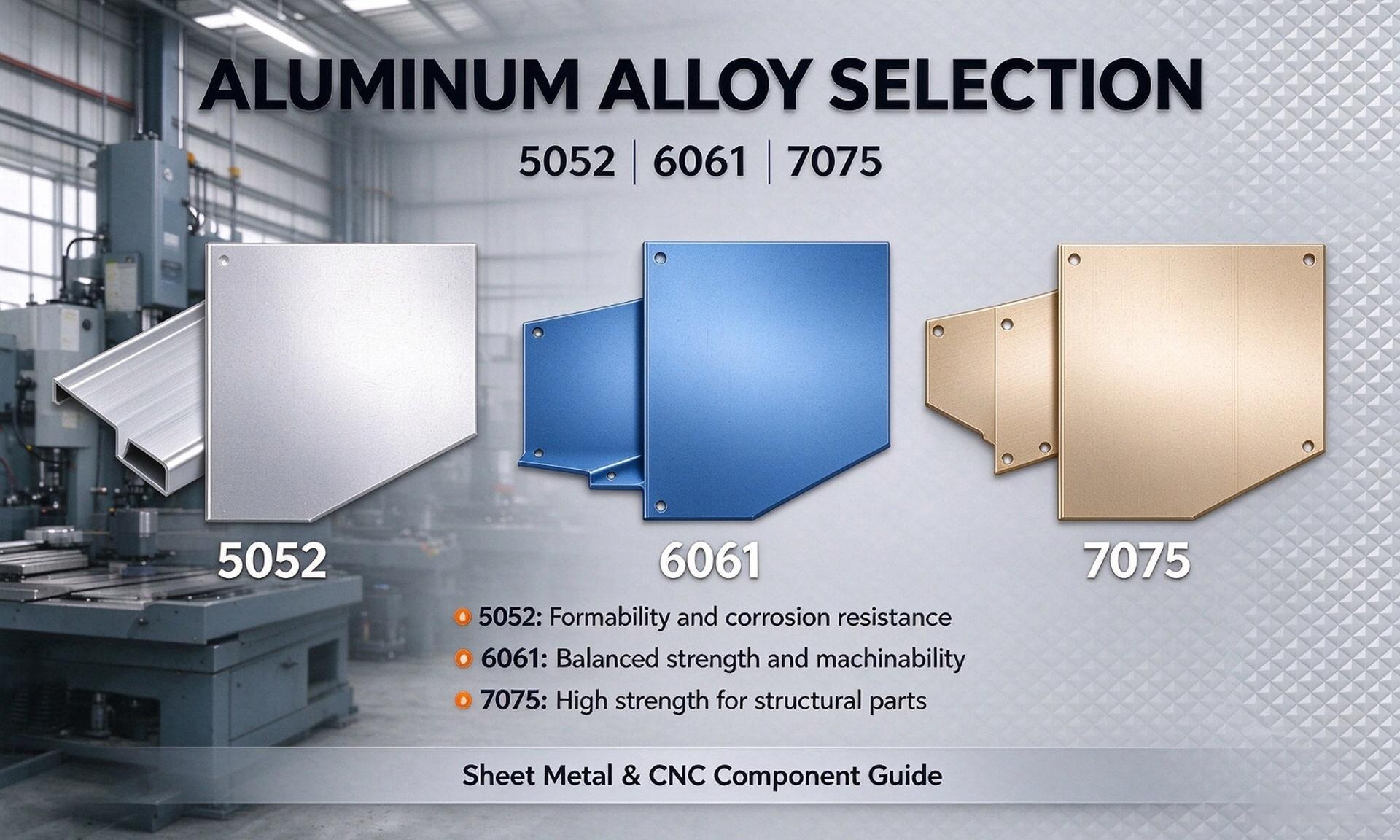
aluminum alloy grades,aluminum for CNC machining, aluminum sheet metal, 6061 aluminum, 5052 aluminum, 7075 aluminum, custom aluminum parts
Aluminum is one of the most widely used materials in sheet metal bending and CNC machining. However, 5052, 6061, and 7075 belong to different alloy systems and behave very differently in forming, welding, machining, anodizing, and strength.
Selecting the wrong material can lead to bending cracks, anodizing defects, insufficient load capacity, or unnecessary cost.
5052 Aluminum
5052 is a 5xxx series aluminum-magnesium alloy and is not heat-treatable.
• Key characteristics: excellent ductility and very good bending performance, making it suitable for tight-radius bends and forming operations. It also has good corrosion resistance and good weldability.
• Strength: generally lower than 6061-T6 and 7075-T6, so it is not the first choice for high-load or wear-critical components.
• Anodizing: can produce a relatively uniform anodized finish.
• Best for: sheet metal brackets, bent panels, water tank components, decorative trailer parts, and applications where extensive bending or welding is required.
6061-T6 Aluminum
6061 is a 6xxx series aluminum-magnesium-silicon alloy, typically used in the T6 tempered condition.
• Key characteristics: offers a good balance of strength, machinability, anodizing response, and cost. It is one of the most versatile alloys for general CNC machined components.
• Machining: generally responds well to CNC machining, with stable chip formation and good surface finish.
• Anodizing: provides relatively consistent color control, making it a preferred choice for black or colored anodized parts.
• Welding: possible, but the heat-affected zone will experience local softening.
• Bending: less formable than 5052. In T6 condition, thick material or small bend radii can cause cracking.
• Best for: CNC structural parts, automation frames, fixture bases, load-bearing brackets, and components requiring a combination of machining, moderate bending, and anodizing.
7075-T6 Aluminum
7075 is a 7xxx series aluminum-zinc-magnesium-copper alloy. It offers very high strength and is often used in aerospace and high-performance applications.
• Key characteristics: high tensile strength, high hardness, and excellent performance in highly loaded CNC components.
• Limitations: very poor ductility, so it is generally not suitable for bending. Weldability is also poor, and welding is usually avoided. Because of its zinc and copper content, 7075 is prone to uneven anodizing, color variation, and streaking.
• Cost: significantly more expensive than 5052 and 6061.
• Best for: high-strength CNC machined parts, tooling locators, heavy-duty mechanical components, and applications without bending or welding requirements.
Quick Selection Guide
• Choose 5052 if bending, forming, or extensive welding is the priority.
• Choose 6061-T6 if you need a balanced combination of CNC machining, anodizing, moderate strength, and cost efficiency.
• Choose 7075-T6 only for high-strength applications with no bending, no welding, and sufficient budget.
Common Design Mistakes
One of the most frequent mistakes is specifying 7075 for a part that also requires tight-radius bending or uniform black anodizing. In practice, that combination is often problematic or impossible.
CTA: If you are uncertain which aluminum grade to use, send us your part requirements, load conditions, bending or welding needs, and surface finish expectations. We can help you select the most cost-effective material and avoid unnecessary development risk.