English
 Español
 Русский
 عربي
Stainless Steel Laser vs Waterjet Cutting: Tolerance, Edge Quality and Real Cost
stainless steel cutting,laser cutting metal, waterjet cutting, sheet metal cutting, metal cutting services, fiber laser cutting, custom metal cutting
Most engineers compare these processes on price per metre. That misleads: they remove material differently and fail differently. What matters is landed cost per good part — cutting, consumables, secondary operations, scrap and inspection.
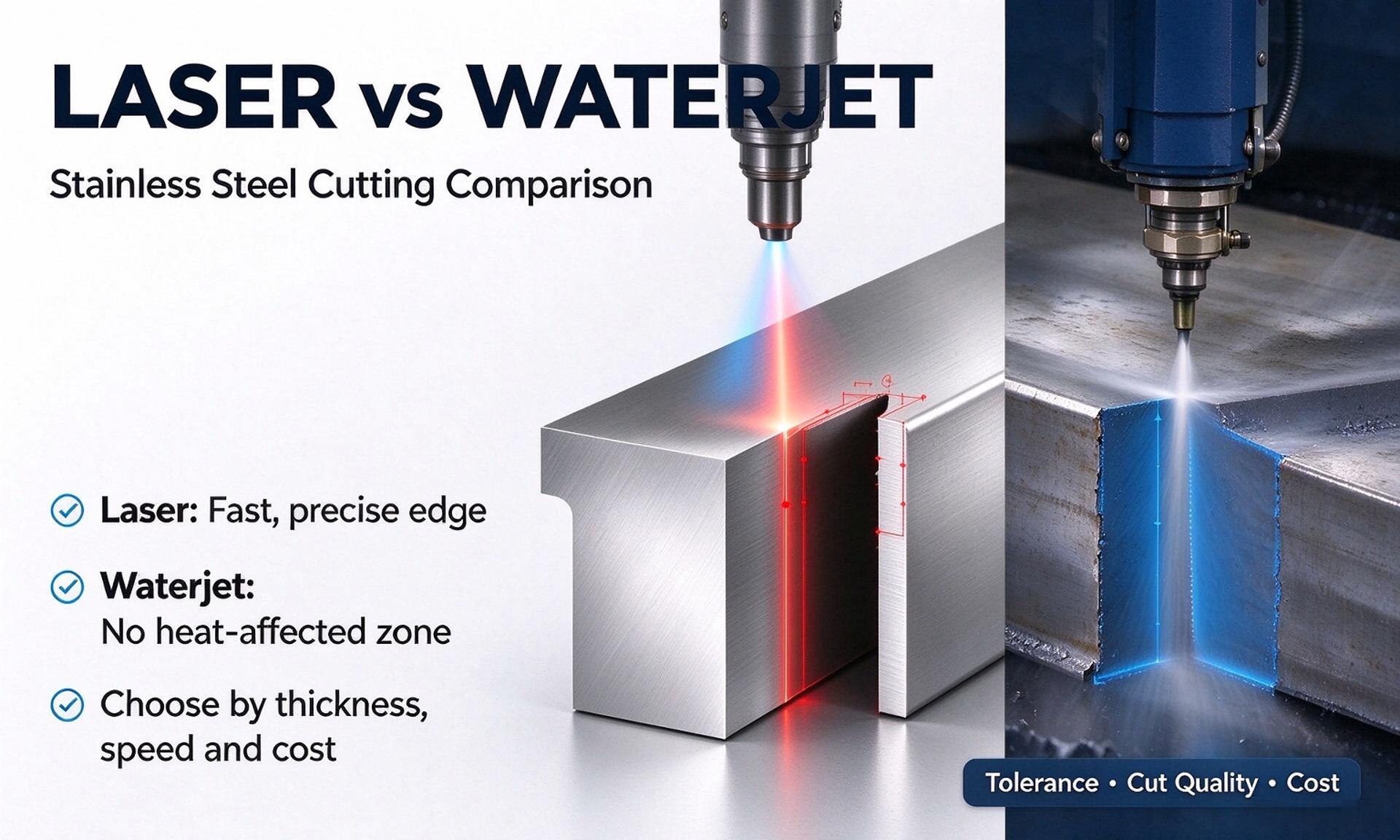
Fiber laser melts the metal with a focused beam and clears it with assist gas. It is thermal: fast and highly repeatable, holding ±0.1 mm on thin gauge and ±0.2–0.3 mm at 10 mm — not the flat ±0.1 often quoted. Large parts should be specified as a ratio, roughly ±0.1 mm per 1000 mm. Kerf is narrow at 0.1–0.3 mm, so nesting efficiency is high. On thin stainless with nitrogen, edges are bright at about Ra 1.6–3.2 µm; on thicker or mirror material you get heat tint, oxide, underside dross and a hardened surface layer. The sweet spot is 6–8 mm; technically 25–30 mm, but slowly.
Abrasive waterjet erodes the metal with high-pressure water and garnet. It is cold: no heat-affected zone, no distortion, no metallurgical change. Tolerance is ±0.1–0.3 mm on thin material and degrades with thickness as the jet spreads. Repeatability is moderate and drifts with nozzle wear and garnet flow. Kerf is 0.8–1.2 mm and the edge is uniformly matte, around Ra 3.2–6.3 µm. Two caveats vendors rarely mention: the kerf has taper, which grows with thickness and speed and affects fit-up; and garnet can lodge in the cut face on thick sections.
The point most comparisons skip is corrosion. Laser heat leaves chromium-depleted grain boundaries in the heat-affected zone. The visible symptom is heat tint; the functional consequence is reduced corrosion resistance at the cut edge. Parts can look perfect and still pit in food, medical, marine or chemical service. The remedy — pickling and passivation to ASTM A380 and A967 — is a real added operation and cost. Waterjet leaves the metallurgy intact, so its edge resists corrosion as supplied.
Cost behaves differently than most buyers expect. Laser's low-consumable reputation comes from thin carbon steel. On stainless it burns high-pressure nitrogen, and on thick plate gas spend can exceed machine time. Waterjet's garnet is the dominant cost, and on thin sheet it is clearly dearer. But the wide kerf wastes more of an expensive alloy: on 316L or duplex, high-volume scrap can claw back several percent. As a rule, below about 6 mm in volume laser wins; 8–12 mm depends on geometry, gas supply and tolerance; above about 15 mm waterjet is often competitive or cheaper, with a better edge.
Choose laser for 304/316 at 6 mm or less, high volume, fine features and tight nesting, where deburring and passivation are acceptable. Choose waterjet for mirror or hardened grades, above 10–15 mm, heat-sensitive or already-machined parts, and anywhere corrosion or weld-edge quality is critical.
Send drawings with grade, thickness, quantity and finish requirements. We will recommend the process, quote both where the choice is close, and give you landed cost per part including secondary operations.